

Kyphosis: causes, symptoms and modern treatment of spinal curvature
Many people notice changes in their back over the course of their lives: increasing back pain, a forward leaning posture or a visibly hunched back. Such complaints can be caused by kyphosis – an increased curvature of the spine, which can occur particularly in the thoracic spine.
The spine naturally has a double S shape, which enables stability and mobility. This natural spinal profile ensures that loads are evenly distributed when walking, sitting or lifting. There is a slight physiological kyphosis in the thoracic region, while there is a lordosis in the lower part of the lumbar spine.
However, if this natural curvature increases, doctors speak of hyperkyphosis. This form of curvature can cause pain, restricted movement and a change in posture. Those affected in particular often report dull pain in the thoracic spine, tension in the neck or restrictions in movement.
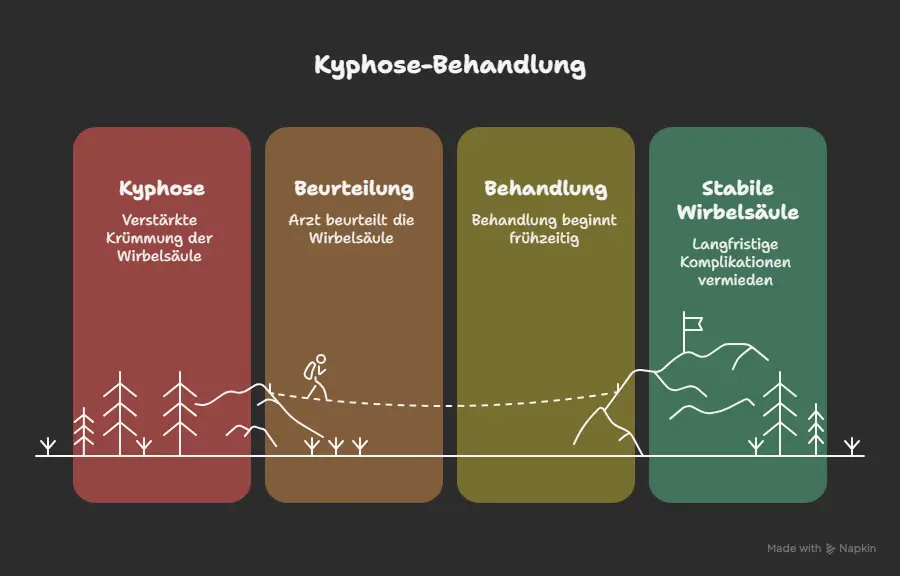
Early assessment by an experienced doctor is important. This is because the earlier treatment begins, the better long-term complications can be avoided and the stability of the spine maintained.
What is kyphosis?
Kyphosis describes a backward curvature of the spine. This form of curvature is initially a normal anatomical variation. In the thoracic spine, it is even part of the natural profile of the spine.
The situation becomes problematic when this curvature increases significantly and hyperkyphosis develops. The spinal profile then changes visibly and the upper body leans forward. In severe cases, a so-called hump or pronounced hunchback develops.
The spine is normally S-shaped. This double curvature provides stability and flexibility at the same time. However, if there is a deviation from this S shape, a misalignment can occur that leads to pain and functional limitations in the long term.
Hyperkyphosis particularly frequently affects the thoracic spine (thoracic spine). In some cases, adjacent sections such as the lumbar spine or the neck can also be affected, which can lead to a complex curvature of the entire spine.
It is important for patients to know: Not every visible kyphosis is automatically a disease. Many people have slight normal variations that do not require treatment. The decisive factors are the extent, possible symptoms and the underlying causes.
Causes of kyphosis
There are many causes of kyphosis. In many cases, it is caused by changes in the spine, the vertebral bodies or the back muscles.
One of the most common causes in adolescence is Scheuermann’s disease, which plays a central role in the orthopaedic treatment of spinal disorders in children. This growth disorder of the vertebral bodies causes the spine to curve backwards more in the thoracic spine area. Adolescents and children in particular develop a pronounced hunchback.
Inflammatory diseases can also cause hyperkyphosis. A well-known example is ankylosing spondylitis, also known as ankylosing spondylitis. This chronic disease causes the spine to become increasingly stiff, resulting in a progressive curvature.
Other possible causes are
Degenerative diseases of the spine
Osteoporosis with sintered fractures of the vertebral bodies
Congenital malformations
Traumatic injuries to the spine
Muscular dystrophies with weak back muscles
Lifestyle also plays a role. Prolonged sitting, poor posture or permanent poor posture can lead to postural kyphosis. This form occurs particularly in young people and can often be improved with targeted therapy.
In some cases, kyphosis also develops as a result of other spinal deformities, such as scoliosis. These and other spinal disorders with deformities are often assessed together. While scoliosis causes a lateral curvature, kyphosis mainly affects the backward curvature.
Symptoms and possible complaints
The symptoms of kyphosis can vary from person to person. Some sufferers initially only notice a change in posture or an increasingly hunched back.
Typical complaints are
Dull pain in the area of the thoracic spine
Back pain with strain
Tension in the neck and upper back
visible hump
restricted mobility
In severe cases, a pronounced curvature can also lead to breathing difficulties. If the chest is compressed by the curvature of the spine, the lung volume can be reduced.
Very rarely, neurological complications arise if the curvature exerts pressure on the spinal cord. Numbness can then occur in the arms or legs.
For many patients, kyphosis is also a cosmetic problem, as the upper body appears to lean forward significantly. In addition to physical pain, this can also cause psychological stress.
Diagnostics: How is kyphosis diagnosed?
A precise assessment of the spine is crucial in order to plan the right treatment. An experienced doctor will therefore begin with a thorough clinical examination.
Among other things, the Adams pre-bend test is carried out. This simple examination shows whether there is an abnormal curvature of the spine or additional scoliosis.
Imaging procedures are necessary for a precise analysis. These include
X-rays of the spine
Magnetic resonance imaging (MRI)
CT examinations if necessary
The so-called Cobb angle is measured on lateral X-ray images. This value shows the extent of the curvature and helps to decide on possible treatment methods.
Early diagnosis is particularly important in children and adolescents. At this stage, the spine is still growing, so timely treatment can prevent further curvature.
Treatment of kyphosis
The treatment of kyphosis depends on the severity, causes and individual complaints of the patient and ranges from conservative to surgical spinal therapies.
In many cases, conservative therapy is the first priority. This includes
Physiotherapeutic exercises
Strengthening the back muscles
Posture training
Breathing exercises
These measures improve the stability of the spine and can significantly reduce pain. Regular exercise is particularly important, as active back muscles support the natural shape of the spine and can prevent complaints, especially in the lumbar spine as the number one problem area.
Brace therapy can be used for adolescents with Scheuermann’s disease. An individually fitted corset stabilizes the spine during growth and prevents further curvature.
A corset can also help to improve posture and stabilize the curvature in other conditions.
When an operation can be useful
In some cases, conservative therapy is not sufficient. If the hyperkyphosis is severe or continues to increase despite treatment, surgery may be necessary.
Surgical treatment is particularly suitable for
severe pain
clear misalignment
neurological complications
severe deformities
During the operation, the spine is corrected and stabilized. A modern screw rod system is often used. These implants connect several vertebral bodies together and correct the curvature.
The procedure is known as spondylodesis or spinal fusion. The aim is to straighten and permanently stabilize the spine.
Modern surgical techniques enable precise correction of the spine. Nevertheless, surgery is only ever recommended if conservative treatment methods are not effective enough.
The decision for an operation should therefore be made in a specialized center and after a detailed consultation with the patient, whereby it is often advisable to obtain a second opinion before spinal surgery.
Living with kyphosis
Many people with kyphosis can lead an active life. Early diagnosis, individually tailored therapy and regular exercise are crucial.
Physiotherapy exercises strengthen the back muscles, improve posture and reduce back pain. Consistent treatment can prevent long-term complications, especially in young sufferers.
The stability of the spine can also be improved in adulthood. An active lifestyle, ergonomic sitting and regular exercise are important.
Anyone seeking information about possible causes, symptoms or modern treatment should seek medical advice at an early stage. Timely assessment can help to stabilize the shape of the spine in the long term and maintain the patient ‘s quality of life.


